
Achilles Tendinitis Microembolization
-

- Tweet
- Share


Vascular Surgery Associates, LLC
Vascular Surgery & Podiatry located in Bel Air, MD & Towson, MD
Persistent Achilles tendon pain can make walking, climbing stairs, exercising, or simply getting through the day uncomfortable. If Achilles tendinitis or Achilles tendinopathy has not improved with rest, physical therapy, activity modification, medication, orthotics, or other conservative treatments, Achilles tendinitis microembolization may offer another treatment option.
At Vascular Surgery Associates, LLC, our vascular specialists provide advanced, image-guided embolization procedures for chronic musculoskeletal pain. Achilles tendinitis microembolization is a minimally invasive procedure designed to target abnormal blood vessels associated with chronic inflammation and pain around the Achilles tendon without traditional tendon surgery
Achilles Tendinitis Microembolization Q&A
What is Achilles tendinitis?
The Achilles tendon is the strong band of tissue connecting the calf muscles to the heel bone. It plays an important role in walking, running, climbing stairs, jumping, and pushing off the ground.
Achilles tendinitis describes irritation and pain involving the tendon. When symptoms become persistent, the condition is often referred to as Achilles tendinopathy, because chronic tendon pain may involve changes within the tendon rather than inflammation alone.
Symptoms may include:
- Pain or aching behind the ankle or above the heel
- Tenderness along the Achilles tendon
- Stiffness, particularly after resting or first thing in the morning
- Pain during walking, running, or exercise
- Swelling or thickening around the tendon
- Difficulty pushing off the foot
- Pain that becomes worse with increased activity
Achilles tendinopathy is common among runners and athletes but can affect anyone. Symptoms may persist for months despite conservative treatment and can interfere significantly with exercise, work, and everyday activities.
/assets/production/practices/3abcdacb115ecb13f02bfcc2a2b34880fab2d7e5/images/2859616.png)
How is Achilles tendinitis usually treated?
Most patients begin with conservative treatment. Depending on the severity and cause of your symptoms, treatment may include:
- Activity modification
- Physical therapy
- Stretching and strengthening exercises
- Supportive footwear or orthotics
- Anti-inflammatory or pain medication when appropriate
- Temporary immobilization in some cases
- Other nonsurgical therapies recommended by your provider
Many patients improve with these treatments. However, some develop chronic Achilles tendon pain that persists despite several months of appropriate conservative care.
For these patients, Achilles tendinitis microembolization may provide another minimally invasive option before more invasive treatment is considered.
What is Achilles tendinitis microembolization?
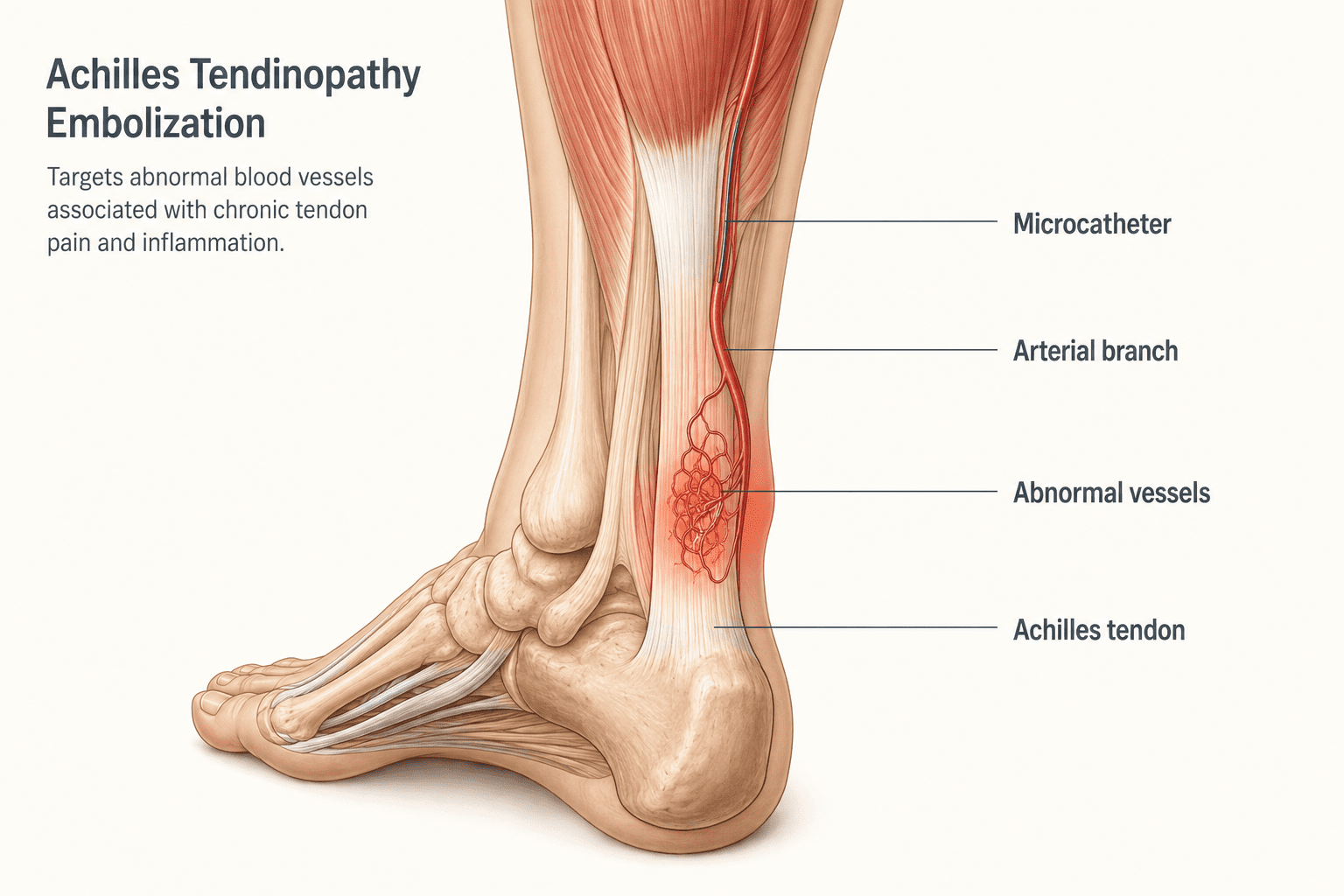
Achilles tendinitis microembolization, also called transarterial embolization (TAE) or transcatheter arterial microembolization, is a minimally invasive, image-guided procedure for chronic Achilles tendon pain.
Chronic tendinopathy may be associated with the development of abnormal tiny blood vessels, known as neovascularity, around painful areas of the tendon. These abnormal vessels may accompany nerves and inflammatory processes involved in persistent pain.
During embolization, your vascular specialist uses X-ray imaging to identify small arteries supplying the painful region around the Achilles tendon. A very small catheter is guided into the appropriate vessels, and an embolic material is delivered to selectively reduce abnormal blood flow.
The goal is to interrupt the cycle of abnormal vascularity, inflammation, and pain while preserving normal circulation to the foot and ankle.
Why might embolization help chronic Achilles tendon pain?
Research into chronic Achilles tendinopathy has identified increased or abnormal blood vessel formation around painful areas of the tendon in some patients.
Achilles embolization is designed to target these abnormal vessels rather than cutting or repairing the tendon itself.
By selectively decreasing abnormal blood flow around the painful area, treatment may help reduce the biological processes contributing to ongoing pain.
Early clinical studies of Achilles tendon embolization have reported meaningful improvements in pain and function among selected patients whose symptoms had not responded to conservative treatment. Because this remains an emerging treatment, results vary and not everyone with Achilles pain will be an appropriate candidate.
Who is a candidate for Achilles tendinitis microembolization?
You may be considered for Achilles tendon embolization if you have:
- Persistent Achilles tendon pain
- Achilles tendinitis or tendinopathy confirmed through medical evaluation
- Symptoms that have continued despite conservative treatment
- Pain that limits walking, running, exercise, work, or other daily activities
- Tenderness localized to the Achilles tendon
- Imaging or other findings consistent with chronic Achilles tendinopathy
- A desire to consider a minimally invasive treatment before surgery
Embolization is generally intended for chronic Achilles tendinopathy rather than an acute Achilles tendon injury or rupture.
Your specialist will review your symptoms, physical examination, imaging, circulation, prior treatments, medications, and overall medical history before determining whether embolization is appropriate.
Is Achilles embolization an alternative to Achilles tendon surgery?
For selected patients, it may provide an additional option before considering surgery.
Achilles microembolization does not involve surgically cutting, debriding, or repairing the Achilles tendon. Instead, treatment is performed through the blood vessels using a small catheter.
Potential advantages include:
Minimally invasive treatment
The procedure is performed through a very small arterial access site rather than an open surgical incision over the Achilles tendon.
Targeted therapy
Your specialist uses real-time imaging to identify and selectively treat abnormal blood vessels associated with the painful area.
Outpatient treatment
The procedure can generally be performed in an outpatient setting, allowing patients to return home afterward.
No surgical disruption of the tendon
Because treatment takes place through the arteries, the tendon itself does not need to be surgically opened.
An option for persistent symptoms
Embolization is primarily considered for patients whose Achilles tendon pain continues despite appropriate conservative care.
Whether embolization or another treatment is most appropriate depends on the cause and severity of your Achilles symptoms.
What happens during Achilles tendinitis microembolization?
Before treatment, your Vascular Surgery Associates team reviews your medications and medical history and provides specific instructions for the day of your procedure.
You may receive local anesthesia and sedation to keep you comfortable.
Your vascular specialist creates a tiny access point in an artery and inserts a thin catheter. Using real-time X-ray imaging and contrast dye, the catheter is carefully guided through the arterial system toward the vessels supplying the painful area around the Achilles tendon.
The specialist identifies abnormal areas of increased blood flow and selectively delivers an embolic material into the targeted vessels.
You generally should not feel the catheter moving through your arteries, although you may notice pressure around the access site.
Once treatment is complete, the catheter is removed and your care team monitors you during recovery.
What should I expect after Achilles tendon embolization?
Achilles microembolization is generally performed as an outpatient procedure, so most patients can return home the same day. Because sedation may be used, you will typically need a responsible adult to drive you home.
Your care team will provide instructions regarding activity, medications, care of the catheter access site, and when you can gradually resume exercise.
Improvement is not necessarily immediate. The goal of embolization is to reduce the abnormal vascular and inflammatory processes contributing to chronic pain, so symptoms may improve progressively following treatment.
Your specialist may also recommend rehabilitation, stretching, strengthening, physical therapy, or other measures as part of your overall recovery.
How effective is Achilles tendinitis embolization?
Clinical research into Achilles tendon embolization is growing.
Studies involving patients with chronic Achilles tendinopathy that did not respond to conservative therapy have reported substantial improvements in pain and Achilles-related function following embolization. Follow-up studies have also reported sustained improvement in many treated patients.
However, Achilles tendon embolization remains an emerging treatment. Individual outcomes vary, and additional research is continuing to determine which patients benefit most and how the procedure fits into the overall treatment of Achilles tendinopathy.
Your Vascular Surgery Associates specialist can discuss the available evidence, potential benefits, alternatives, and realistic expectations based on your individual condition.
What are the risks of Achilles tendinitis microembolization?
Like any catheter-based procedure, Achilles tendon embolization has potential risks. These may include:
- Bruising or bleeding at the catheter access site
- Temporary discomfort
- Contrast dye reaction
- Blood vessel injury
Services
-
Abdominal Aortic Aneurysmmore info
-
Achilles Tendinitis Microembolizationmore info
-
Aneurysmsmore info
-
Ankle Discolorationmore info
-
Arterial Blockagesmore info
-
Arterial Diseasemore info
-
Carotid Artery Diseasemore info
-
Claudicationmore info
-
Deep Vein Thrombosismore info
-
 Diagnostic Consultationmore info
 -
Dialysis Accessmore info
-
Elbow Embolizationmore info
-
Genicular Artery Embolization (GAE)more info
-
Knee Arthritismore info
-
Leg Discolorationmore info
-
Leg Painmore info
-
Leg swellingmore info
-
Lymphedemamore info
-
Pelvic Congestion Syndromemore info
-
Peripheral Artery Angioplasty Treatmentmore info
-
Peripheral Vascular Diseasemore info
-
Plantar Fascia Embolizationmore info
-
Podiatrymore info
-
Sclerotherapymore info
-
Spider Veinsmore info
-
Strokesmore info
-
Ulcersmore info
-
Varicose Veinsmore info
-
Varithena Microfoam Vein Treatmentmore info
-
Vascular Surgerymore info
-
Vascular Ultrasoundmore info
-
VenaSealmore info
-
Wound Caremore info
